

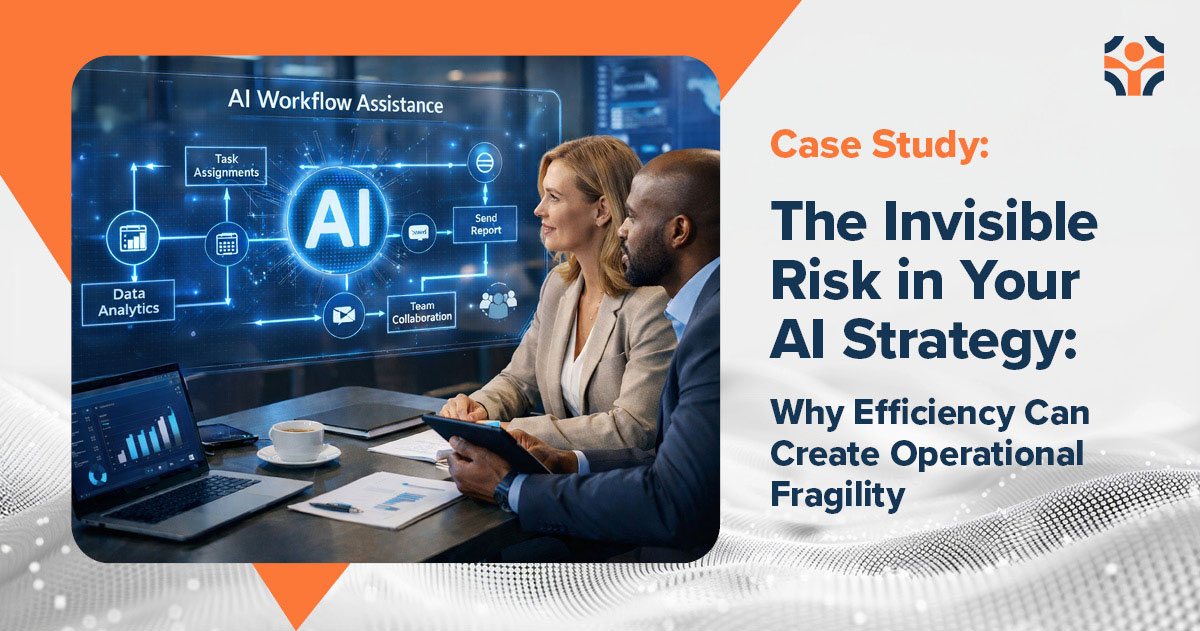
The Invisible Risk in Your AI Strategy: Why Efficiency Can Create Operational Fragility
Many business owners pursue AI to improve efficiency and reduce founder dependency. However, without proper governance and architectural oversight, AI systems can create hidden operational fragility. This article explores why AI strategy should be treated as a risk management priority rather than an administrative upgrade, and how structured implementation protects long term business value.
The Invisible Risk in Your AI Strategy: Why Efficiency Can Create Operational Fragility
Many business owners pursue AI to improve efficiency and reduce founder dependency. However, without proper governance and architectural oversight, AI systems can create hidden operational fragility. This article explores why AI strategy should be treated as a risk management priority rather than an administrative upgrade, and how structured implementation protects long term business value.
Why Efficiency Can Create Operational Fragility
Across international markets, AI integration has become a boardroom mandate. Automate workflows. Reduce overhead. Decrease founder dependency. Improve speed.
The ambition is rational.
The execution, in many cases, is not.
A growing number of business owners are approaching AI implementation as an administrative exercise rather than a strategic risk management decision. That distinction matters more than most realise.
Recently, I reviewed a project brief from a multi-entity investor seeking assistance to “redesign workflows and reduce founder dependency” through AI systems. The objective was operational leverage. Sensible, even necessary.
Yet the proposed execution model exposed a far greater vulnerability than the dependency it aimed to solve.

The Rise of Shadow Infrastructure
When AI systems are built informally, delegated to part-time hires, or assigned to operational generalists, something subtle but dangerous begins to form.
Shadow infrastructure.
This occurs when the core logic of your reporting systems, financial oversight processes, communication workflows, or property management automation lives inside undocumented prompts, loosely connected tools, or the private knowledge of a single contractor.
On paper, the business looks more efficient. Processes run. Reports generate. Dashboards populate.
But structurally, the organisation becomes brittle.
If one individual understands how the logic works, how the automations connect, and how exceptions are handled, then dependency has not been eliminated. It has simply shifted.
Founder dependency has been replaced with systemic fragility.
If that individual exits, access is lost, documentation is incomplete, or logic fails under pressure, the business is left with a black box. Outputs continue until they do not. When something breaks, no one understands why.
This is not operational leverage. It is concealed risk.
Automation Does Not Equal Governance
Efficiency is not the same as resilience.
Many AI deployments focus on surface-level gains. Inbox triage. Meeting summaries. Task management. Content drafting. These are useful applications, but they do not address structural risk.
There is a material difference between:
- Administrative AI – Using tools to streamline routine tasks and improve responsiveness.
- Structural AI – Designing integrated systems that enforce financial controls, expose hidden linkages, centralise oversight across entities, and preserve governance integrity.
- Administrative AI improves comfort.
- Structural AI protects value.
For investors managing multiple entities across jurisdictions, or founders stepping back from daily control, this distinction becomes critical. AI should not merely accelerate activity. It should enhance visibility, strengthen verification mechanisms, and reduce the probability of unseen failure.
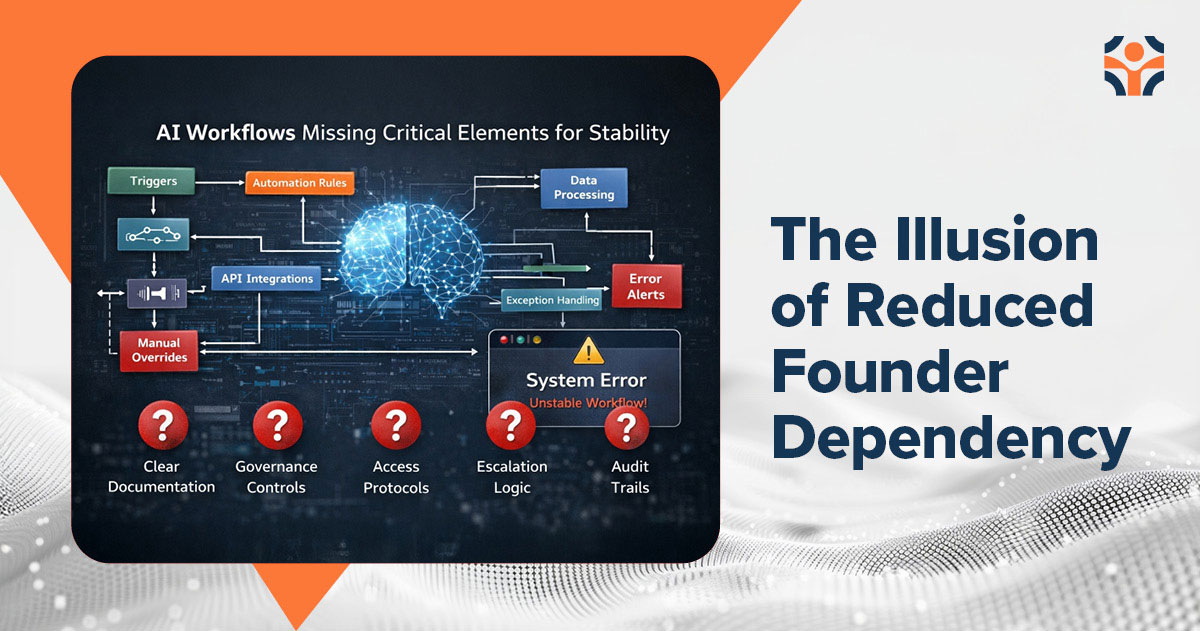
The Illusion of Reduced Founder Dependency
Many founders believe that implementing AI systems reduces reliance on themselves. In reality, poorly structured AI often embeds their thinking into fragile workflows without formalising it.
When workflows are redesigned without:
- Clear documentation
- Governance controls
- Access protocols
- Escalation logic
- Audit trails
The business may appear independent, but it lacks institutional strength.
A highly experienced assistant can be a valuable operational asset. However, operational competence is not the same as systems architecture.
Architecting resilient AI infrastructure requires:
- Risk modelling
- Logic mapping across entities
- Data governance frameworks
- Scenario testing
- Cross-border compliance awareness
- Contingency planning
Without this backbone, AI becomes a productivity layer placed on top of structural uncertainty.
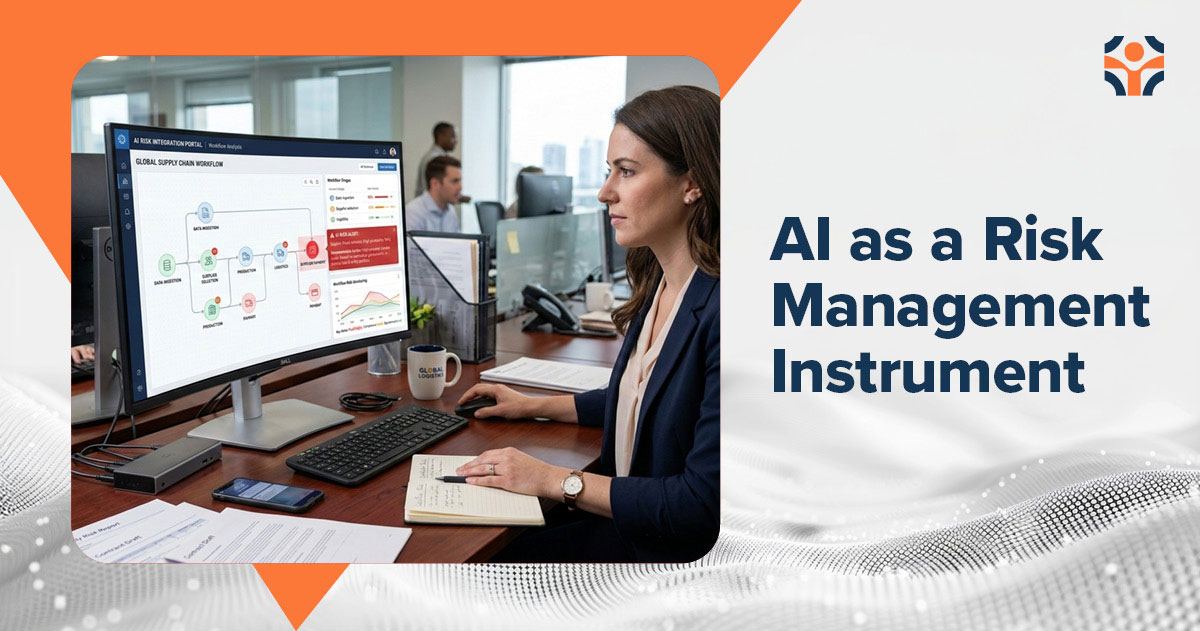
AI as a Risk Management Instrument
At Insight Intel, we evaluate AI integration through a strategic intelligence lens.
The question is not, “How can this tool save time?”
The question is, “What risks does this system eliminate, expose, or amplify?”
AI should deliver:
- Rapid, verifiable evidence
- Transparent reporting structures
- Link analysis across financial and operational entities
- Early visibility into anomalies
- Governance reinforcement, not dilution
In complex international structures, clarity is more valuable than convenience.
When AI is architected correctly, it becomes a control mechanism. It strengthens oversight. It documents logic. It creates traceability. It reduces key-person exposure.
When implemented casually, it does the opposite.
The Outcome-First Approach
If your objective is to reduce dependency and increase business value, your AI strategy must be treated as infrastructure, not experimentation.
This requires:
- Defining the risk outcomes you want to eliminate
- Mapping where informational blind spots exist
- Designing systems that enforce governance automatically
- Ensuring no single individual holds undocumented control
- Building redundancy and verification into the architecture
- The goal is not simply smoother operations.
The goal is certainty.
The Strategic Imperative
The current market enthusiasm for AI has created a dangerous narrative that integration is inherently beneficial. In reality, poorly structured AI can accelerate the consequences of weak governance.
Efficiency without oversight increases exposure.
Automation without architecture creates fragility.
Delegation without documentation transfers risk.
Business owners should not hire someone to experiment with AI inside critical systems. They should engage professionals who understand intelligence architecture, operational risk, and structural integrity.
AI is not a toy, and it is not merely an assistant.
It is infrastructure.
And infrastructure determines whether your business withstands pressure or fractures under it.
If you are reducing founder dependency, ensure you are not increasing systemic vulnerability in the process.
The real return on AI is not speed.
It is certainty, governance, and controlled visibility across your enterprise.